Wednesday, March 21, 2012


The Decemberists have been one of my favorite bands for many years now.  I first got turned on to them a couple years before the release of their fourth full-length album, The Crane Wife.  Previous to the release of The Crane Wife the Decemberists had found their niche in folky, nautically themed indie rock.  Their palette of sounds, timbres, and instruments was far more extensive than any of their contemporaries.  They have used some instruments I had never heard of (and I’m a music major who works in an instrument office) that bring a quaint and nostalgic feeling to the music.  For a man who pays little to no attention to lyrics, lead-singer Colin Meloy’s word-smithery really caught my attention from the get-go.  While his voice borders on whiny and has been subject to criticism by some who have heard it, his genius as a lyricist is undeniable.  
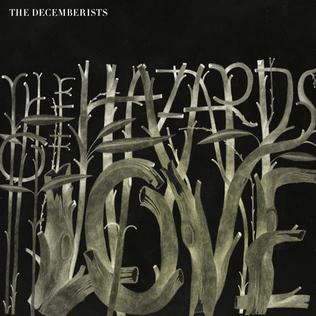
While this formula has worked well for them and their relatively large fan base, they really mixed things up with their fifth full-length album, The Hazards of Love.  This was an epic undertaking on many levels.  The album is an honest-to-goodness rock opera complete with a fully developed plot, characters, and reoccurring motifs.  While The Crane Wife has some reoccurring themes and stories, its scope is not the same as The Hazards of Love.
           The Hazards of Love tells a fairy tale-like love story of Margaret, a typical town’s person, and William, the adopted son of the Queen of the Forest.  The story follows them as they try to remain together despite objections of the Queen and the advances of the Rake, a despicable character who’s after Margaret for the most sinister of reasons.  While Colin Meloy does the voice of both William and the Rake, Becky Stark of Lavender Diamond and Shara Woden of My Brightest Diamond were brought in to do the voices of Margaret and the Queen respectively.  
          Aside from the operatic style or storytelling, there are other changes from previous Decmeberists’ albums.  There are a couple of tracks that rock much harder than most previous Decemberist albums.  A Bower Scene and Won’t Want for Love (Margaret in the Taiga) specifically have a great crunchy guitar sound and heavy bass.  These were the first songs I heard before I had a chance to listen to the whole album.  I was really surprised (pleasantly so, I might add) by the heaviness of the sound and The Decemberists really pull it off well.  The mainly folk-driven group shows a much edgier side that contrasts well with the rest of the album.  There are typical sounding Decemberists tracks like The Hazards of Love 2 and The Hazards of Love 1 that would have been right at home on any other Decemeberists’ album but in context serve as plot development as well as a calm before the storm of harder songs.  The instrumental interludes are some of the highlights of the album.  You'll find them sprinkled throughout the album and they're 
          All this being said, this album is one of the best albums to have come out in the past ten or so years.  I’m truly impressed by the song writing and planning that went in to such an undertaking as a true rock opera.  The musicianship is impeccable and the fact that they did an entire tour where they played the entire album just as it sounds adds greatly to my respect.  I recommend everyone everywhere listen to the whole thing.  I literally teared up when I listened to the final track.  It’s an emotional journey as much as it is a musical journey and I hope it’s a journey you’ll soon take.  

Tuesday, March 20, 2012

Unplugged.

Recently some roommates and I participated in a special event known as "Eric Clapton Week".  It is more or less a religious observance for the King of Blues.  Like many religious services we put aside distractions (in this case all other music) and focused our efforts on what really mattered (crunchy solos and face melting licks).  At first I was skeptical, I am by no means a new convert to Eric Clapton's work, but a whole week?  A man can only listen to so much blues.
Wrong.
Let's start with the blues.  So much of what Eric Clapton is and plays comes from the 8 and 12 bar blues.  My uncle Stallion Cornell once said about the blues something that has stuck with me - "The blues, like jazz, sounds like a lot of fun to play, but generally sounds like boring drivel to all those listening".  In many respects I agree.  Repeating the same three chords over and over again would tend to bore me, but there is something in the blues that resonates in me.  I think it all started when I told my Pandora station that I liked Muddy Waters and it proceeded to play nothing but Chicago and Louisiana blues from old 1950's African-American artists....for three days.  Needless to say I came out of that experience crooning like Howlin' Wolf, and looking for more.
I grew up listening to Clapton Unplugged in the backseat of Dr. Jimmy Senior's Subaru Impreza, to which I'm eternally grateful (unlike Dr. Jimmy Senior's love for all things Andrea Bocelli, which I hope is just a 10 year passing phase).  When I purchased my first iPod and began putting all the music on it that I could get my hands on I found the Clapton Unplugged CD buried far back in our family's CD collection.  I dusted off the case and decided to put it on my newly purchased mp3 playing device, thinking that I should have some sort of Clapton on my iPod and promptly forgot that it was ever there.  Then something amazing happened to me - I discovered the shuffle setting of my iPod.  Walking to and from campus at the university where I teach/attend/am the dean of students, my shuffle kept spewing Clapton Unplugged at me and I kept skipping the songs, considering them relics from the archives of my iTunes.  Then I gave up - I listened to a song off the album - probably the first time since I was about 8 - and it was "Running on Faith".  I was hooked.
Eric Clapton is the King of Blues for a lot of reasons that are all apparent on this album.  He doesn't play the guitar, he never plays the guitar - it is merely another appendage that does exactly as he pleases.  His voice is not just smooth, its creamy like the first scoop of perfect temperature ice cream.  Some songs are just pure blues - "San Francisco Bay Blues", "Walkin' Blues", "Malted Milk", these songs sound like the only friend this man has left is his delightful Martin Co. guitar.  The lyrics are so good :
 "Baby, fix me one more drink and hug your daddy one more time, keep on stirring my malted milk, mama, until I change my mind"
"I ain't got a nickel and I ain't got a lousy dime. She don't come back, think I'm going to lose my mind. If she ever gets back to stay, it's going to be another brand new day, Walking with my baby down by the San Francisco Bay".

There are some Clapton classics on it as well - Layla,  Before You Accuse Me, Tears in Heaven, etc.  which he adapts to acoustics perfectly.  The transition is made easier by the fact that he has an awesome band backing him up (like always), especially the piano player who he refers to a few times as "Chuck".  The blues come through so pure on these tracks, and it converted me forever.
 I came out of college understanding a little more about the blues, but it wasn't until this Eric Clapton week that I became aware that he is the best.  The best.
If you have ever wanted to play a guitar, have listened to a guitar, or have a vague idea of what a guitar looks like - stop whatever silly thing you are doing and purchase this album.  You can thank me with monetary donations (just put "Dr. Jimmy" on the envelope, the mailman will know where it is to go).  

Dr. Jimmy